Quantum workflows for research and engineering teams
Find out whether your quantum workload can deliver.
Assess whether it can run with your available resources and meet your result-quality targets. Q-Alchemy connects data loading, circuit compression, and result extraction.
Choose your starting point
Compare free, platform, and OEM accessFeasibility Suite business access
Available now for businesses. Customers can request early access ahead of the November 2026 public release.
Request Feasibility Suite accessQ-Alchemy Console — in development. Our upcoming browser interface for the Feasibility Suite.
The problem we solve:making quantum data usable.
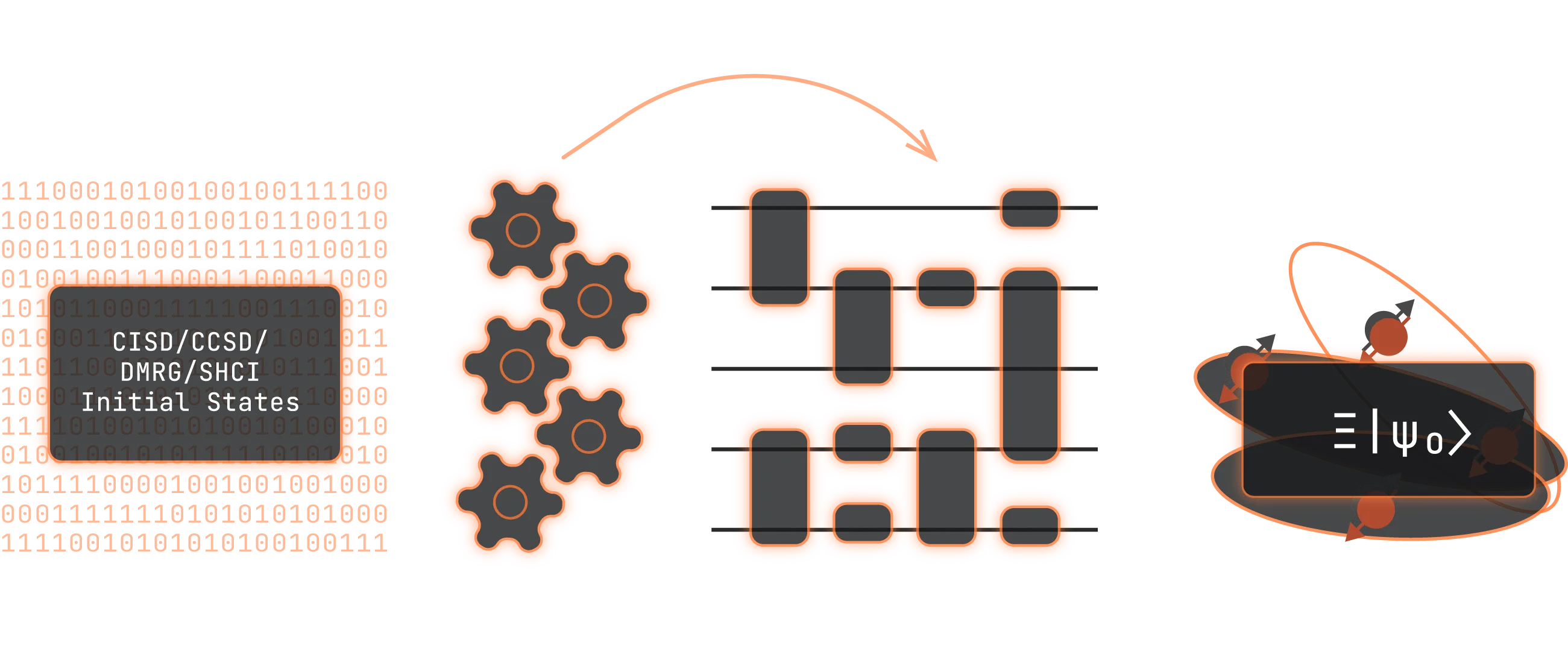
Quantum workflows need more than an algorithm: they need efficient data loading, useful result extraction, and compact circuits. Q-Alchemy connects all three.
1
Data loading
Preparing classical data as a quantum state can dominate circuit cost. We exploit structure to build compact preparation circuits with a configurable accuracy budget.
2
Result extraction
Measurements give samples, not a complete state. We extract observables and fit compact state models, checking their predictions against independent measurements.
3
Circuit compression
Long circuits demand more gates and execution time. We find smaller circuit implementations while preserving their behavior for the intended inputs.
Quantum hardware access
Part of the IBM Quantum Network startup program
data cybernetics ssc GmbH participates in the IBM Quantum Network startup program. Q-Alchemy is a product of data cybernetics. Quantum credits provided through the program enabled our molecular state preparation experiments on IBM quantum hardware.
Explore our quantum chemistry results
IBM and IBM Quantum are trademarks or registered trademarks of IBM Corp., in the US or other countries or both.
Numbers with context
The cost of a dense statevector
Storing every amplitude doubles the memory for each additional qubit. At 40 qubits, one dense statevector needs 16 TiB at double precision. Explore this storage baseline below.
Sparse simulation stores populated amplitudes and their indices. Tensor methods exploit other structure. Their costs depend on the state and its evolution, so qubit count alone does not establish classical infeasibility or quantum advantage.
Assess your workload with the Feasibility SuiteDense statevector memory
16 MiB
220 = 1,048,576 complex amplitudes
Assumes 16 bytes per complex amplitude (complex128). Memory = 16 × 2n bytes. Binary units: 1 MiB = 220 bytes; 1 GiB = 230; 1 TiB = 240; 1 PiB = 250. Simulator workspace, extra state copies, and runtime are excluded.
See the memory table and assumptionsQ-Alchemy
Q-Alchemy brings data loading, result extraction, and circuit compression into your quantum workflow. Prepare structured inputs, recover useful information from measurements, and reduce circuit cost with tools built around Qiskit.
Read more about the algorithmState Preparation Grounded in Research
Use Q-Tucker methods to turn structured classical inputs into quantum circuits, balancing preparation accuracy and circuit cost.
Explore Q-Tucker and the paperWork with Your Python Workflow
Use the Python SDK with Qiskit and PennyLane integrations, or export preparation circuits as OpenQASM for the next stage of your experiment.
See SDK integrationsAssess Resources and Result Quality
Check whether your workload can run within available classical or quantum resources, and examine its quality against explicit targets.
Explore the Feasibility SuiteQuantum Chemistry on Real Hardware
Prepare molecular states, collect measurements, and reconstruct compact models. We demonstrated this workflow across twelve molecular systems on IBM quantum hardware.
Explore quantum chemistryWhy Q-Alchemy?
Set your API key and install the SDK first.Follow the complete setup guide.
import os
import numpy as np
from q_alchemy.initialize import q_alchemy_as_qasm

state = np.array([1, 0, 0, 1], dtype=complex) / np.sqrt(2)
qasm, summary = q_alchemy_as_qasm(
    state,
    max_fidelity_loss=0.0,
    api_key=os.environ["Q_ALCHEMY_API_KEY"],
    return_summary=True,
)
print(qasm)
print(summary)
import os
import numpy as np
from qiskit.quantum_info import Statevector, state_fidelity
from q_alchemy.qiskit_integration import QAlchemyInitialize, OptParams
state = np.array([1, 0, 0, 1], dtype=complex) / np.sqrt(2)
prep = QAlchemyInitialize(
params=state.tolist(),
opt_params=OptParams(
max_fidelity_loss=0.0,
api_key=os.environ["Q_ALCHEMY_API_KEY"],
),
).definition
print(prep.draw(output="text"))
fidelity = state_fidelity(Statevector.from_instruction(prep), Statevector(state))
print(f"Local simulation fidelity: {fidelity:.6f}")import os
import numpy as np
import pennylane as qml
from q_alchemy.pennylane_integration import QAlchemyStatePreparation, OptParams
state = np.array([1, 0, 0, 1], dtype=complex) / np.sqrt(2)
dev = qml.device("default.qubit", wires=2)
@qml.qnode(dev)
def circuit():
QAlchemyStatePreparation(
state,
wires=[0, 1],
opt_params=OptParams(
max_fidelity_loss=0.0,
api_key=os.environ["Q_ALCHEMY_API_KEY"],
),
)
return qml.probs(wires=[0, 1])
print(circuit()) # Expected approximately [0.5, 0.0, 0.0, 0.5]Public research funding
Funding for data cybernetics
data cybernetics ssc GmbH is funded by the German Federal Ministry of Research, Technology and Space (BMFTR) for the QROM research project.
Q-Alchemy is a product of data cybernetics.